.png)

Appcues is a customer engagement platform. Teams use it to reach, encourage, and engage their customers from inside their own product — publishing dynamic content, offers, surveys, and multi-step guides that appear based on who someone is and what they've actually done.
The mechanic underneath is simple to describe and hard to build: Appcues watches behavior across the user experience, works out what each person needs next, and delivers it in the moment that matters. In-app, by email, or by push. Without waiting on a release cycle.
That's the definition, but the more useful question is why a company needs Appcues at all.
Most companies have spent a decade getting very good at acquisition and then watching many of their rapid feature launches fail land.
The signal that helps a launch land sits in the product. It all comes down to user behavior: every click, every stall, and every feature someone opened once and never returned to.
The problem is who can reach it. Analytics tools show that signal to the people who can only act on it by adding to an engineering roadmap. Marketing automation lets marketers act, but only outside the product, in channels customers are already ignoring. And anything that changes what happens inside the product has historically required engineering time nobody has.
So marketing sends an email about a feature the customer already abandoned. Meanwhile ,product ships an onboarding flow nobody measures. Customer success finds out about the churn risk out of nowhere in the renewal call.
Appcues closes that gap. The behavior becomes the trigger, the product becomes the channel, and the person who owns the relationship gets to act on both.
It turns out that marketers' instincts were never the problem. It all comes down to access an scaleability.
Appcues is built for the people accountable for outcomes that depend on user behavior inside a product they don't build.
The common thread: everyone on that list needs to change what a customer sees inside the product, and none of them want to file a ticket to do it.
Buying usually gets approved by a CMO or VP of Marketing, sometimes a CPO or VP of Product. Executives evaluate on leverage and proof. The operators who'll live in the tool evaluate on something narrower and more honest — how long it takes to get from an idea to a live experience.
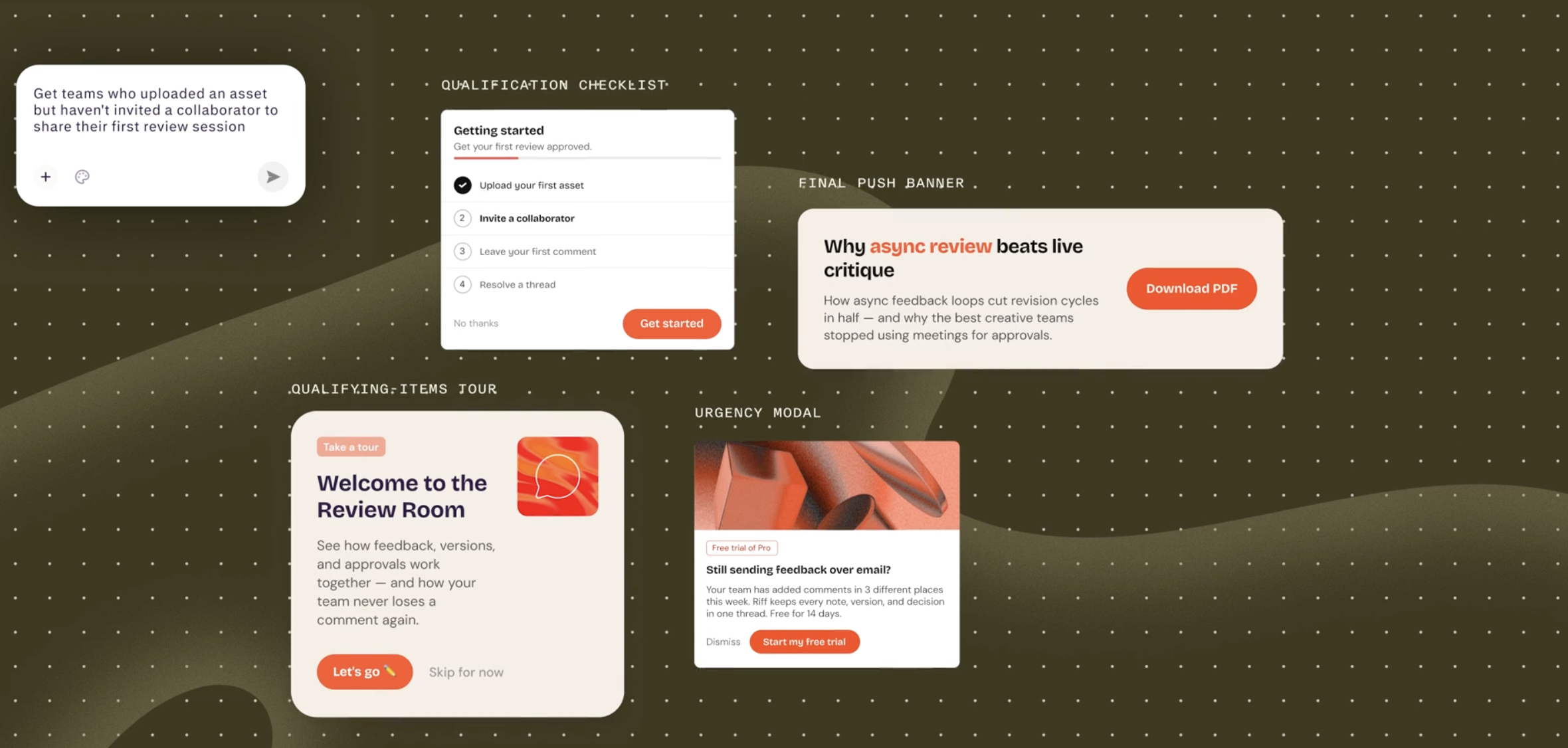
Craft Experiences. Build in-app messaging and multi-step journeys using flows, modals, tooltips, slideouts, banners, checklists, pins, embeds, launchpads, and NPS or survey forms. Load your brand guide once and let the platform design to it — or design it yourself.
Build Segments. Define audiences from behavioral actions and user attributes, not just static lists. "Opened the reporting tab twice and never saved a report" is a segment.
.png)
Drive Outcomes. Organize experiences into campaigns tied to a stated goal.
Get Analytics. Trends, funnels, paths, retention curves, dashboards, and reports with AI-generated summaries — plus impact and uplift measurement so you can separate "this happened" from "we caused this."
Leverage AI. A multi-agent system that builds experiences, surfaces opportunities, suggests fixes, analyzes data, and keeps your account tidy. You can edit anything it produces, and a human has to approve every experience before a customer sees it.
.png)
The rebuilt Appcues is structured around a Workspace — a prompt-driven interface where you describe what you're trying to do in plain language and the platform does the assembly.
Bring your context. The Knowledge Hub takes your brand guide, your glossary, how your product works, and what you're trying to hit this quarter. Brief it once, and every draft, recommendation, and report runs with that context instead of starting from zero.
Connect your data. Native integrations with Salesforce, HubSpot, Intercom, Slack, Mixpanel, and Heap. Webhooks and API for the rest. An Appcues MCP server makes your Appcues data queryable from Claude, ChatGPT, or any MCP client — useful when the question you have at 4pm doesn't match any dashboard you've built.
Map actions to outcomes. Tell the platform which events matter and what they mean. Define a campaign around a goal, and the tactics underneath it inherit that goal.
Publish. In-app leads — it's the only channel where you can reach someone at the exact moment they're stuck. Email and push extend the same behavior-triggered sequence outward when someone leaves.
Analyze and optimize. Track what moved, get recommendations on what to change, and run the next cycle with more context than the last one.
There's also a native mobile SDK, so mobile experiences ship without an app-store release.
Appcues organizes all of this around four phases. It's the framework most of the product's structure follows, and it's the most useful way to understand what you'd actually do with the tool.
Three things speed the wheel up:
The flywheel only works if the same team can see the signal and act on it. Split those across two tools and two org charts and you get a slideshow, not a flywheel.
These are the tactical use cases, in roughly the order teams adopt them.
User onboarding. Guide new users to first value with checklists, flows, and contextual tooltips. This is where most companies start, and it's still the fastest thing to prove. Shorter time-to-value, higher activation, better week-four retention.
Trial conversion. Target trial users by behavior rather than by day number. Someone who's hit the value moment on day two needs a different message than someone who's logged in twice and done nothing.
Feature adoption. Announce a feature in-app to the segment most likely to care, then follow with a walkthrough for the people who clicked and stalled. Announcement alone is a press release. Announcement plus a guide is adoption.
Product launches. Coordinate in-app, email, and push around one launch moment, with the in-app piece timed to when someone is actually in a position to try the thing.
Product feedback. Microsurveys and NPS triggered at milestones — right after someone completes a key action, when the answer means something, instead of on a quarterly blast.
Upsell and cross-sell. Surface an offer when usage says someone is ready for it, not when the billing calendar says so.
Mobile engagement. Same behavior-triggered logic, delivered natively, without waiting on an app store review.
Self-serve support. Launchpads put help, docs, and guides inside the product so people find answers where they got stuck. Fewer tickets, and better ones.
Reviews and referrals. Ask the customers who just hit a milestone, at the moment they hit it.
Easier to use, faster to master. The install needs a technical resource once. After that, the people who own the outcome publish the experiences — no ticket, no sprint, no queue.
AI that moves from insight to action. Plenty of platforms will tell you where users get stuck and draw you a funnel. The difference here is what happens next: you ask what to do about it, you get a suggestion, and you can have it built. Every experience still goes through a human before it goes live.
Measurement that answers "did we cause this?" Most analytics tools are very good at telling you what happened. Impact and uplift measurement tell you whether your campaign is the reason it happened. Everyone measures; the useful question is what you change next.
Analytics is included on every Appcues plan. It's designed to sit alongside the analytics stack you already have, not to replace it.
A system that compounds. Most tools forget everything between campaigns. Appcues holds onto your context, your audience, and the patterns that moved your numbers, and uses them to build the next one.
An app crew, not a ticket queue. A consultative team that works on your program with you.
No nickels or dimes. Every plan gets every feature.
Install is a JavaScript snippet. First-time setup usually wants a developer for an hour — someone has to put the snippet in and confirm events are flowing. Pretending otherwise just sets up a bad first week.
After that, it's yours. Most teams are up and running in as little as two days. Campaigns are commonly live within two weeks of onboarding. A free trial is available after a call with the team.
The thing that determines how fast you get value isn't the install. It's whether you've decided what you're trying to move. Teams that show up with a goal ship a campaign in week one. Teams that show up wanting to "try some tooltips" are still trying some tooltips in month three.
Appcues uses simple, all-inclusive packaging. Every plan includes AI, analytics, and unlimited seats — you get the full platform regardless of company size, and pricing scales with usage. Businesses under 25 employees can ask about the Spark Plan.
For current numbers, see the pricing page.
Across the customer base, teams average +13.6% activation, −13.2% time-to-value, +7.8% free-to-paid conversion, +14.3% feature adoption, +10.2% NPS, and +6% net revenue retention.
G2 users rank Appcues highest for ROI, ease of use, and fastest implementation.
If you want to see the platform against your own product, book a call. If you'd rather poke at it yourself first, explore the platform.
Either way, bring a number you're trying to move. It's a much better first conversation than a feature list.
Lifecycle Marketing
Email Marketing
Retention & Churn
Customer Engagement
TL;DR
Appcues is a customer engagement platform. Teams use it to reach, encourage, and engage their customers from inside their own product — publishing dynamic content, offers, surveys, and multi-step guides that appear based on who someone is and what they've actually done.
The mechanic underneath is simple to describe and hard to build: Appcues watches behavior across the user experience, works out what each person needs next, and delivers it in the moment that matters. In-app, by email, or by push. Without waiting on a release cycle.
That's the definition, but the more useful question is why a company needs Appcues at all.
Most companies have spent a decade getting very good at acquisition and then watching many of their rapid feature launches fail land.
The signal that helps a launch land sits in the product. It all comes down to user behavior: every click, every stall, and every feature someone opened once and never returned to.
The problem is who can reach it. Analytics tools show that signal to the people who can only act on it by adding to an engineering roadmap. Marketing automation lets marketers act, but only outside the product, in channels customers are already ignoring. And anything that changes what happens inside the product has historically required engineering time nobody has.
So marketing sends an email about a feature the customer already abandoned. Meanwhile ,product ships an onboarding flow nobody measures. Customer success finds out about the churn risk out of nowhere in the renewal call.
Appcues closes that gap. The behavior becomes the trigger, the product becomes the channel, and the person who owns the relationship gets to act on both.
It turns out that marketers' instincts were never the problem. It all comes down to access an scaleability.
Appcues is built for the people accountable for outcomes that depend on user behavior inside a product they don't build.
The common thread: everyone on that list needs to change what a customer sees inside the product, and none of them want to file a ticket to do it.
Buying usually gets approved by a CMO or VP of Marketing, sometimes a CPO or VP of Product. Executives evaluate on leverage and proof. The operators who'll live in the tool evaluate on something narrower and more honest — how long it takes to get from an idea to a live experience.
Craft Experiences. Build in-app messaging and multi-step journeys using flows, modals, tooltips, slideouts, banners, checklists, pins, embeds, launchpads, and NPS or survey forms. Load your brand guide once and let the platform design to it — or design it yourself.
Build Segments. Define audiences from behavioral actions and user attributes, not just static lists. "Opened the reporting tab twice and never saved a report" is a segment.
Drive Outcomes. Organize experiences into campaigns tied to a stated goal.
Get Analytics. Trends, funnels, paths, retention curves, dashboards, and reports with AI-generated summaries — plus impact and uplift measurement so you can separate "this happened" from "we caused this."
Leverage AI. A multi-agent system that builds experiences, surfaces opportunities, suggests fixes, analyzes data, and keeps your account tidy. You can edit anything it produces, and a human has to approve every experience before a customer sees it.
The rebuilt Appcues is structured around a Workspace — a prompt-driven interface where you describe what you're trying to do in plain language and the platform does the assembly.
Bring your context. The Knowledge Hub takes your brand guide, your glossary, how your product works, and what you're trying to hit this quarter. Brief it once, and every draft, recommendation, and report runs with that context instead of starting from zero.
Connect your data. Native integrations with Salesforce, HubSpot, Intercom, Slack, Mixpanel, and Heap. Webhooks and API for the rest. An Appcues MCP server makes your Appcues data queryable from Claude, ChatGPT, or any MCP client — useful when the question you have at 4pm doesn't match any dashboard you've built.
Map actions to outcomes. Tell the platform which events matter and what they mean. Define a campaign around a goal, and the tactics underneath it inherit that goal.
Publish. In-app leads — it's the only channel where you can reach someone at the exact moment they're stuck. Email and push extend the same behavior-triggered sequence outward when someone leaves.
Analyze and optimize. Track what moved, get recommendations on what to change, and run the next cycle with more context than the last one.
There's also a native mobile SDK, so mobile experiences ship without an app-store release.
Appcues organizes all of this around four phases. It's the framework most of the product's structure follows, and it's the most useful way to understand what you'd actually do with the tool.
Three things speed the wheel up:
The flywheel only works if the same team can see the signal and act on it. Split those across two tools and two org charts and you get a slideshow, not a flywheel.
These are the tactical use cases, in roughly the order teams adopt them.
User onboarding. Guide new users to first value with checklists, flows, and contextual tooltips. This is where most companies start, and it's still the fastest thing to prove. Shorter time-to-value, higher activation, better week-four retention.
Trial conversion. Target trial users by behavior rather than by day number. Someone who's hit the value moment on day two needs a different message than someone who's logged in twice and done nothing.
Feature adoption. Announce a feature in-app to the segment most likely to care, then follow with a walkthrough for the people who clicked and stalled. Announcement alone is a press release. Announcement plus a guide is adoption.
Product launches. Coordinate in-app, email, and push around one launch moment, with the in-app piece timed to when someone is actually in a position to try the thing.
Product feedback. Microsurveys and NPS triggered at milestones — right after someone completes a key action, when the answer means something, instead of on a quarterly blast.
Upsell and cross-sell. Surface an offer when usage says someone is ready for it, not when the billing calendar says so.
Mobile engagement. Same behavior-triggered logic, delivered natively, without waiting on an app store review.
Self-serve support. Launchpads put help, docs, and guides inside the product so people find answers where they got stuck. Fewer tickets, and better ones.
Reviews and referrals. Ask the customers who just hit a milestone, at the moment they hit it.
Easier to use, faster to master. The install needs a technical resource once. After that, the people who own the outcome publish the experiences — no ticket, no sprint, no queue.
AI that moves from insight to action. Plenty of platforms will tell you where users get stuck and draw you a funnel. The difference here is what happens next: you ask what to do about it, you get a suggestion, and you can have it built. Every experience still goes through a human before it goes live.
Measurement that answers "did we cause this?" Most analytics tools are very good at telling you what happened. Impact and uplift measurement tell you whether your campaign is the reason it happened. Everyone measures; the useful question is what you change next.
Analytics is included on every Appcues plan. It's designed to sit alongside the analytics stack you already have, not to replace it.
A system that compounds. Most tools forget everything between campaigns. Appcues holds onto your context, your audience, and the patterns that moved your numbers, and uses them to build the next one.
An app crew, not a ticket queue. A consultative team that works on your program with you.
No nickels or dimes. Every plan gets every feature.
Install is a JavaScript snippet. First-time setup usually wants a developer for an hour — someone has to put the snippet in and confirm events are flowing. Pretending otherwise just sets up a bad first week.
After that, it's yours. Most teams are up and running in as little as two days. Campaigns are commonly live within two weeks of onboarding. A free trial is available after a call with the team.
The thing that determines how fast you get value isn't the install. It's whether you've decided what you're trying to move. Teams that show up with a goal ship a campaign in week one. Teams that show up wanting to "try some tooltips" are still trying some tooltips in month three.
Appcues uses simple, all-inclusive packaging. Every plan includes AI, analytics, and unlimited seats — you get the full platform regardless of company size, and pricing scales with usage. Businesses under 25 employees can ask about the Spark Plan.
For current numbers, see the pricing page.
Across the customer base, teams average +13.6% activation, −13.2% time-to-value, +7.8% free-to-paid conversion, +14.3% feature adoption, +10.2% NPS, and +6% net revenue retention.
G2 users rank Appcues highest for ROI, ease of use, and fastest implementation.
If you want to see the platform against your own product, book a call. If you'd rather poke at it yourself first, explore the platform.
Either way, bring a number you're trying to move. It's a much better first conversation than a feature list.

Sign up for Quickcues and get our monthly updates!
.svg)